



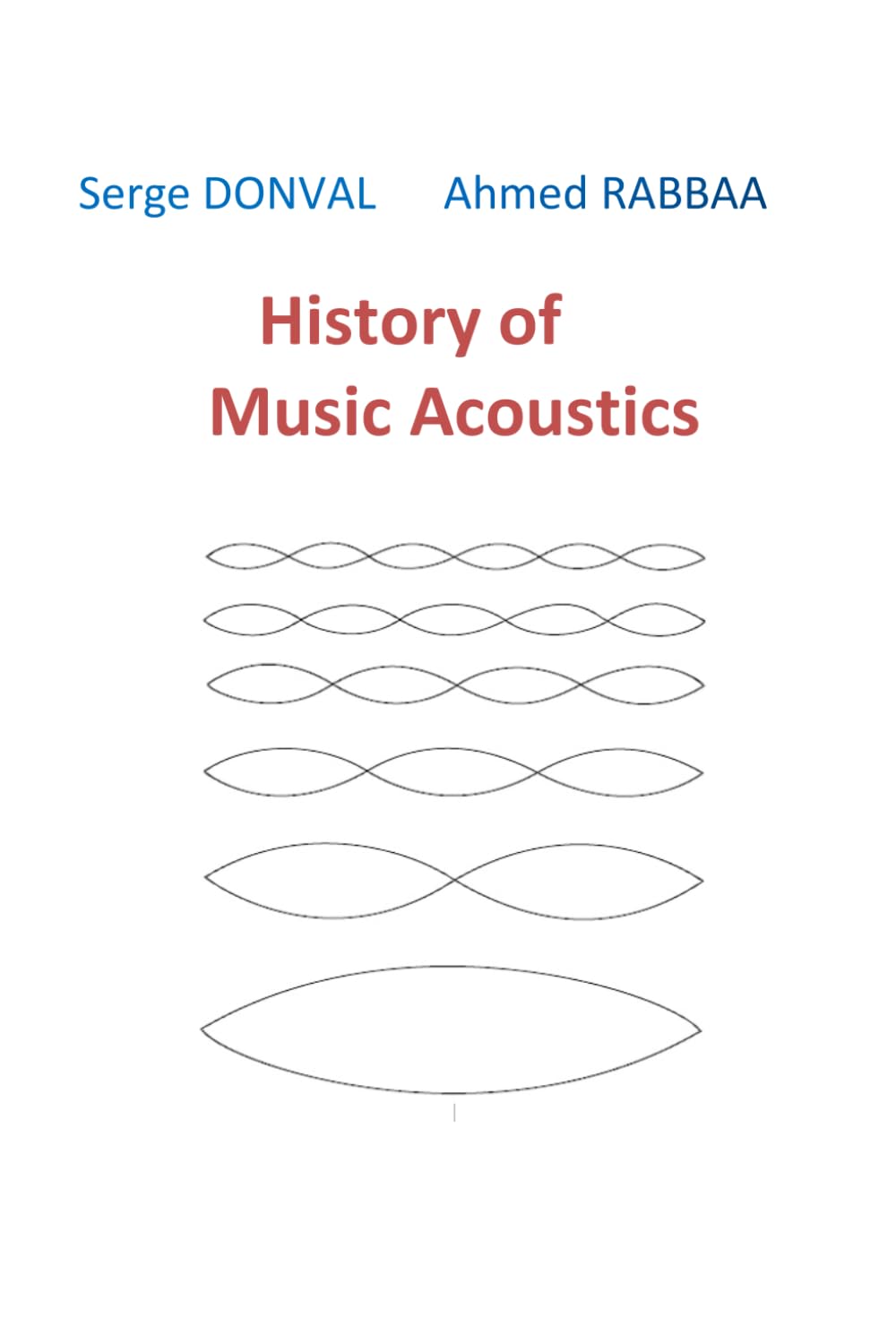
History of Music Acoustics Paperback – December 4, 2024

 4.2 (39 items)
 Limited Time Sale
US$12.00 cheaper than the new price!!
Free cash-on-delivery fees for purchases over $99
Product details
| Management number | 220486531 | Release Date | 2026/05/03 | List Price | US$8.00 | Model Number | 220486531 | ||
|---|---|---|---|---|---|---|---|---|---|
| Category | |||||||||
The purpose of this book is to make a complete study of musical (or music) acoustics and its evolution through History, from the Renaissance (and even before) to the present day. History, Tradition and other socio-cultural factors have had much influence on music (and its theory), often to the detriment of the basic rules of acoustics; all this will be explained with full scientific arguments. The first 2 chapters deal with acoustics. Chapter III focuses on the harmonics (a common topic and a bridge between music and acoustics) and their use in building the musical scale. Chapter IV explains the reasoning which leads to the “Circle of the Fifths”. The Consonance, in chapter V, is the core of fundamental Music Theory. Temperaments have got their own general chapter VI. Afterwards, Zarlino’s (chapVII) and various meantone tunings (chapVIII-IX) are reviewed in details where some historical elements are useful for their understanding. The term microtonality (chapX) refers to scales of more than 12 steps per octave : we’ll study divisions such as 17, 19, 24, 31, 43. The most (maybe all) of them were designed for the sake of “Just Intonation”, which recommends that the scale should contain a maximum of consonant notes (III.2) : third 5/4, fifth 3/2, seventh 7/4, etc. All these notes derive from the harmonics of the tonic (or root). As for the 2 next chapters, each has its own features while remaining linked to the topic of this book, and both fall within the author's sphere of competence (acoustics, harmonics, computer and electronics) : Acoustics and Electro-acoustics (XI), Music and Computer (XII). The last 3 chapters explore the great 3 styles of what is qualified as “non-western” music : Arab or Middle-Eastern (XIII), Indian (XIV) and Chinese (XV). The content is clear and simple, with a logical and pedagogical evolution. It is not necessary for the reader to have an advanced training but rather a skeptical and open mind. All the notions needed to understand the content are explained (the author has been teaching for more than 40 years); and for people who don’t have any training in music theory and harmony 2 Appendices will offer them a good background. The present treatise is intended for a wide public : ordinary readers and amateurs of History, musicians, students and professors of music and musicology (and sound technicians). They will find plenty of ideas and arguments presented by an author having a double training in sciences (physics/electronics/mathematics, Doctorat d’Etat in Physics 1986 and CNRS Laureate 1987) and music (Conservatoire graduate in 1993), and possessing a versatile culture (oud or arabic lute, and piano). Read more
| ISBN13 | 979-8301934452 |
|---|---|
| Language | English |
| Publisher | Independently published |
| Dimensions | 6 x 0.47 x 9 inches |
| Item Weight | 13.1 ounces |
| Print length | 206 pages |
| Publication date | December 4, 2024 |
Bestseller ranking
Flexible Shafts




Customers who viewed this product also viewed
American






Correction of product information
If you notice any omissions or errors in the product information on this page, please use the correction request form below.
Correction Request Form